A few thoughts on AI use after talking to many people (Thanks, EcoInf GT) and trying Opencode with my own agent and skills (TL;DR opinion: Highly impressive, but easy to loose control).
- We should learn from the vast literature on the speed-accuracy trade-off: In the end, regardless of the use of AI, we should choose where to place our research in this trade-off. I think science tends to lean on the slow and accurate side (but not all tasks are equal). In a nutshell, you can be aided by AI to create a very accurate output, but this will require detailed prompts, careful revision, and a few iterations making it relatively slow, but you can also create a quick, inaccurate output without using AI.
- A hidden danger of AI is eroding community interactions: There is a lot of talk on the dangers of AI removing cognitive friction (with reason!). But it is also eroding the social friction needed to ask for help. Scientists work in teams. Recognizing you don’t know something, that an R code fails or gives weird results, and asking your supervisor, teammates, or experts in the field for help is not easy. On the other hand, asking GenAI doesn’t expose yourself, but you are loosing the oportunity to create a community of practicioners. This community will not only solve your technical problems, but stimulate your critical thinking, tell you about other random stuff, fueling serendipity, and in the long term, they will constitute your support network. If you want a more conspiratorial view… big companies want us isolated, because together we are stronger.
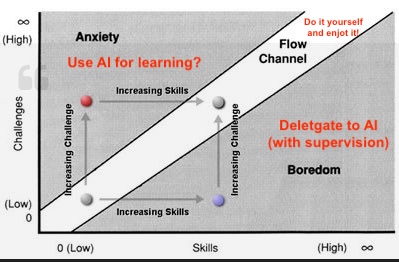
- What are you delegating to AI?: I already posted about the idea of “flow” (doing something difficult with mastery) and how good it feels. I remembered this old graph, and I superimposed the potential AI use in red. Maybe it is a good way of looking at the problem of when to delegate something to AI, when you should enjoy it yourself, and (maybe) when to use AI as a learning platform (although other learning options might be better?).