SCAPE-2012 meeting highlights

Last weekend I attended the SCandinavian Association for Pollination Ecologists (SCAPE) meeting. I had a great time there, with many “big names” among the attendants (and very interesting “small names” too!). Compared to the last ESA meeting I attended in Portland this summer, with more than 4000 people and 13 parallel seasons running all day, having only 60 people in the same cozy room was a change. Both formats has its functions, but I think is usually more productive the small and informal gathering.

Before a brief summary of the best talks (according to my biased interests), I want to mention that I am surprised on the big gap between population ecologists (mainly plant ecologists) and community ecologists (networks and landscape stuff). I am clearly guilty of only thinking at the community (and ecosystem) levels, so it was nice to be reminded about genes and specific process occurring at lower levels.

Four talks I liked:

Amots Dafni gave a great talk dismounting and old and beautiful hypothesis suggesting that floral heat reward attracts males to overnight inside the flower, and hence pollinate the plant. Despite the idea is neat, and flowers are indeed around 2ºC warmer than the environment, warmer flowers (those facing east and getting the morning sunlight) did not host more bees. They also show that no other reward is offered, and that no bee-attractive volatile compound was produced as a deceptive attraction mechanism (like the one in some orchids). The icing of the cake was showing that the bees visually perceive the flower entrance as a hole or crevice (i.e. black), indicating that the most parsimonious explanation is that flowers use shelter mimicry to attract the males. For me the most important point was to don’t get too attached to beautiful hypothesis, as often they are not supported when tested rigorously.

Erin Jo Tiedeken (in Jane Stout lab) showed that bumblebees (B. terrestris) can not detect natural levels of toxics (both natural plant toxics and insecticides) in the nectar (lab conditions). Most toxic compounds have low volatility, so that’s bad news for bees exposed to Neonicotinoids.

Robert Junker showed that floral bacterial community is more similar among flowers of different plants, than among different organs (e.g. leafs) of the same plant. Not sure what to do with that, but it’s intriguing!

Jan Goldstein did an experiment (unfortunately un-replicated) removing a network hub from a plant-pollinator network. This is a common practice on simulations to assess robustness of the networks. In those simulations when a species loses all their links is assumed to disappear from the network, however, Jan showed that most species visiting the hub, just change its visitation pattern to another plant when this hub is removed experimentally (i.e. re-wiring). Tarrant and Ollerton have a similar experiment with consistent results and I hope its published soon.

My slides here.
Why analysing your data is like being in a romantic relationship

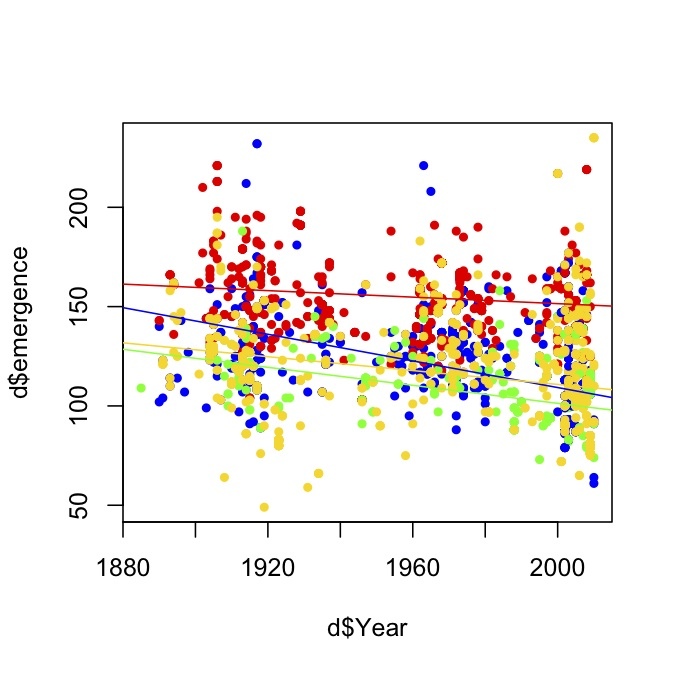
Last year I was working on a big dataset to assess how bee phenology has changed over time. Here it is the first cool figure I produced. I was quite excited so I didn’t even bother to make beautiful axes.

I am pretty sure the stats I finally used changed quite a lot, and I also added many more data points before publishing the results (it toke me a year to sort out all details), but the main result held. Bees are emerging earlier in recent time periods that they used to emerge. The final published figure looks like that:

While cleaning my computer today, I realised that my first plot looks way more colourful and exciting than the final figure I ended up publishing. Then, I remembered a text I wrote about analyzing data…

“I almost forgot the fun of first analysis when everything is new and exciting, when you want to know everything about “data” and you learn from “her” everyday… it’s a shame that after that it becomes repetitive and monotonous. You’ve lost the magic, but on the other hand, it’s also nice to really get to know each other, you gain compromise and confident results.”

So maybe my own plots can prove I was right, and Data analysis is like a love story. Are your first drafts also more pasional than the final version?


keep up with the literature…

sciseekclaimtoken-50660e34020be

I just find a 2009 paper I missed. How many of those will be out there? I did a commentary (Bartomeus & Winfree 2011) last year on how to track bee movements along different habitats. I did a quite intense literature research and I still missed this very relevant paper (Brosi et al 2009). Sorry, I have no excuses for not citing the paper on the commentary, and despite is true that I don’t usually read that Journal, I like a lot the first author work, so here my little amend:

I would like to have highlighted the paper in my commentary because despite the promising ideas it contains, no advance has been made in this direction in the subsequent years. Maybe other researchers missed that paper too? The paper propose using stable isotopes to track habitat use by pollinators. Despite the known correlation between habitat structure and pollinator diversity and abundance, little is known on which habitats use different pollinator species and specially in which proportions. This knowledge is important to understand the effect of land use change on pollinator persistence, but can be used for answering multiple questions ranging from ecosystem services to pollinator population dynamics. The main limitation faced by researchers so far is the inherent difficulty to track individual specimens movements.

The goal of the paper is to utilize the naturally occurring differences in isotopic composition among habitats to characterize habitat-based bee foraging changes within a landscape context. In this case they characterize the use of agricultural or forested areas. The researchers found a significant relationships between the carbon and nitrogen isotope signals on bees depending on the season, the landscape context and the local biotic context. Though they could not estimate proportions of different habitat uses due to high variances in the stable isotopes signal, they claim that this important step can be achieved in other systems. If so, the ability to calculate isotope mixing models (which estimate the proportion of different habitats use) would be useful for most investigations of pollinator foraging in the context of ecosystem services.

References:

Bartomeus I., Winfree, R. (2011) The Circe Principle: Are Pollinators Waylaid by Attractive Habitats? Current Biology 21(17): 653-655

Brosi, B.J., Daily, G.C., Chamberlain, C.P. & Mills, M. (2009). Detecting changes in habitat-scale bee foraging in a tropical fragmented landscape using stable isotopes, Forest Ecology and Management, 258 (9) 1855. DOI: 10.1016/j.foreco.2009.02.027