
Is there a pollination crisis?

After some months writing this blog, finally I can do some self-promotion and post about our new article just published in PNAS.

Do you think we are experiencing a pollinator crisis? Take note of your answer and keep reading.

In this paper, we show that most Northeastern US bee species persisted along the last 100 year. And those are 100 years that has transformed the landscape dramatically. However, we show that community composition changed markedly. The loser species are some big species, often specialists and with short activity periods. See a quick figure I made trying to capture the essence to outreach people who only have one minute to spare.

BartomeusPNAS

So, what that tell us about a possible pollination crisis? A crisis is something that leads to an unstable and dangerous situation, in this case regarding the fate of pollinators and the service they deliver. Nobody talks about a bird crisis. Some bird species are doing great, some are threatened with extinction, but nobody would dare to generalize about the fate of all bird species as a whole. I think is time we take the same approach with such a diverse group as the pollinators (including bats, birds, butterflies, bees and a long etc…). In this paper we show that some bumblebees (e.g. Bombus impatiens) are doing great, while others are on the brink of extinction (e.g. Bombus affinis). We need to understand better species responses and stop crying wolf for all pollinators. There is a fine line between raising general aware among citizens about the importance of pollinators and their conservation and an overestimated alarmist call. Every time a farmer reads about the pollination crisis while seeing that his field is full of bees buzzing around, we (scientists) are loosing credibility.

Moreover, if is crop pollination and food security what concerns you, it may be that the winner pollinator species, those that thrive in human dominated landscapes, are also the best ecosystem service providers. And if it’s biodiversity (and its overall functioning) what you want to protect, then we should look at which species/habitats needs maximum conservation. We need to move forward and pose the relevant questions, instead of looking for a general declining pattern that hopefully is not really there.

I am expanding too much for my taste, so more on that next week. But to make clear my point: we need to keep studying pollinators (keep funding me!), but next time you cite worldwide pollinator declines, cite me also (i.e. Pots et al 2010, but see Bartomeus et al 2013).

Bartomeus I., Ascher J.S., Gibbs J., Danforth B.N., Wagner D.L., Hedtke S.M. & Winfree R.  Historical changes in northeastern US bee pollinators related to shared ecological traits, Proceedings of the National Academy of Sciences,   DOI:

*Giving the importance of the subject, it was specially important for us to make all historical bee data available @datadryad (dx.doi.org/10.5061/dryad.…) for further analysis and replicability.
Pollination effectiveness landscape

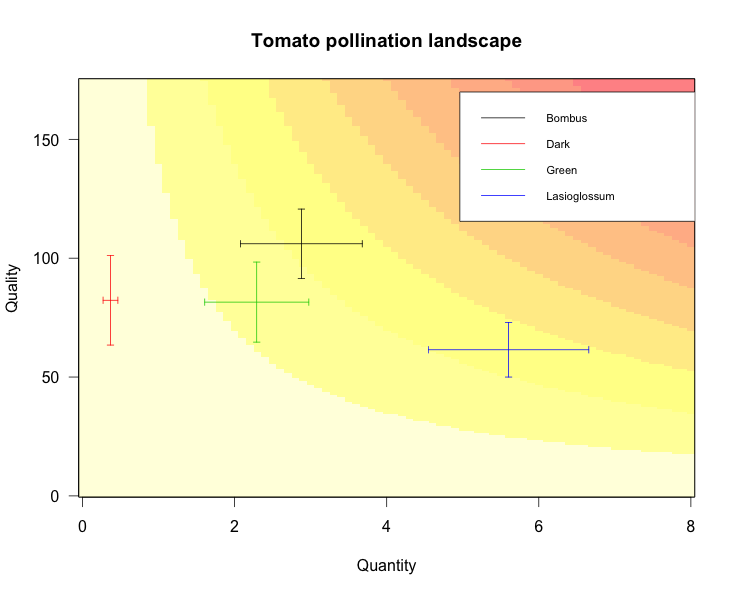
I want to show you a pollination landscape, but this is not a pollinator landscape with flowers and nesting sites, but a plot showing two components of pollination. Quantity and quality. A recent paper by Pedro Jordano (see here for other work on seed dispersal landscapes) inspired me to plot my data that way, which I think is just awesome. I am a little ashamed I can not fully follow the part of his code (but is great that people is sharing code!) dealing with plotting the z axis… but if you have a hammer, all your problems will look like nails. And I had used recently expand.grid( ) and loess( ), so I used those to do my z axis. I also think is nice that people has two options to plot the data. So here is the plot:

plot

Here you just see that bumblebees and Lasioglossum provide similar total pollination levels (yellow), but through different mechanisms (quantity or quality).

Here you can find the code to reproduce the plot.

Biodiversity shared-blog

I am rather a chaotic blog reader. I scan some RSS feeds, check blog aggregators from time to time (R-bloggers and Ecobloggers) and rely on tweeter as a curating tool that brings me the best posts directly to my timeline. Today I discovered http://www.biodiverseperspectives.com/ and it’s clearly a must read.

Cool posts like this one a side, I think is a wonderful idea. Grad students (and faculty) around the globe can register and post about a common topic: Biodiversity (check out their diagram on the upper-right part of the homepage, which covers a lot of ground). Having a personal blog may be not for everyone (I’m still exploring it), so it’s great to have a platform to share something from time to time, and with a nice readership already built.

We know nothing

Today I read a paper about bee population dynamics published in Ecology (Franzen and Nilsson 2013). Given the current concern about bee declines (more on that in a few weeks) one can assume we (scientists) understand the basic dynamics of bee populations, or at least we have an idea of their life histories. Well, the paper monitored one metapopulation of one species during 9 years and found that fluctuations on the number of nests among years are huge (more than one order of magnitude). Why? We don’t know and It is not correlated with floral resources or climate. Some speculations include source-sink dynamics, a prolonged diapause or bet hedging strategies to avoid natural enemies. We know nothing. And you may ask, why is this published in Ecology? Well, because I think is a good paper that at least shows some data. That means that given the knowledge we currently have, this tiny bit of information advances our understanding.

Really basic research is not sexy but can we (and I am the first guilty) understand a pollinator crisis if we don’t know if it is predation or it is competition what is driving bee fitness. Or can we understand the actual structure of plant-pollinator networks, which are characterised by an incredible turn over among years, without knowing if bed hedging strategies are the norm or the exception (Danforth 1999). Can we assess the effect of landscape configuration on bee populations without the basic natural history information like eggs per female, or growth rates?

Image

Franzen M. & Nilsson S.G. (2013). High population variability and source-sink dynamics in a solitary bee species, Ecology, 130204095918002. DOI:

How to decide where to submit your paper (my two cents)

Following Jeremy Fox interesting blog post, and at least three other people follow-up (herehere and here).  Here are my thoughts on where to submit your paper. In a nutshell, I think times are changing. If you are in a strong position, you can bet for the model you think is best. But if you are not settled yet, I think is wise to have a compromise between publishing some old school papers based on journals prestige, but also make your bet by submitting other manuscripts to faster and open access Journals. That way you can defend your position in a variety of situations.

Following Jeremy’s points:

  • Aim as high as you reasonably can. Agreed, but “high” is a vague term. Impact factor is not a reliable measure and “prestige” is difficult to asses. I think like Jan, that the difference is between the 3 top interdisciplinary journals, the top journals of your field, and then everything else. Within this categories, I don’t worry anymore about the journal in terms of “high impact”. (OA discussed below)
  • Don’t just go by journal prestige; consider “fit”. I do think fit is important, but not in terms of people finding your paper (despite lots of researchers keep using TOC’s of a few well-known journals), but because having a type of journal (or reader) in mind helps you frame your article. For example, I’d expect different things from the same title in Am Nat, than in Ecology.
  • How much will it cost? Important only if you don’t have the money.
  • How likely is the journal to send your paper out for external review? I liked Ethan’s advice on the importance of the speed of the process. By maximizing your chances of being sent to review, not only you can accumulate citations faster but also it reduce the amount of frustration.
  • Is the journal open access? Ideally, Yes, is very important for me. In reality, well, my projects rarely have the money to pay for it, so I end up not making them open.
  • Does the journal evaluate papers only on technical soundness? I think this is a model that will substitute all low tier journals. I’m writing mainly three types of papers. Papers that I hope can make a great advance on Ecology and that I would like to see in a top journal. Papers that has an specific niche, and where I want to target people working on this niche. And good papers that I think can make its moderate contribution, and I want them out there fast for people to read. This papers are ideal for open access and evaluated on technical soundness.
  • Is the journal part of a review cascade? Again, completely agree with Ethan. In fact I would love a model where papers are valued on technical soundness and then there is an “editors choice” or something like that.
  • Is it a society journal? I value supporting Societies. But most important: Is the publisher making profit? Is Copyright retained to the author? Society journals or other organisational journals (i.e. PLOS) has the great advantage from my point of view that revert the benefits to the community, and usually they require a licence to publish, but not a copyright transfer. It’s important for me to avoid as much as possible making a business of science.
  • Have you had good experiences with the journal in the past? I don’t think that’s relevant.
  • Is there anyone on the editorial board who’d be a good person to handle your paper? I’ve never thought on that.

Extra stuff:

  • Publish in a diversity of journals: If you want to increase your readership, increase the spectrum of journals you publish. Publish in general ecology Journals, in more specialised journals, Plos ONE stile. That would help you gain experience with the system too.
  • Listen to your feelings: Is there any journal you like (rationally or irrationally) specially? Forget the pros and cons. Publishing is hard, and its also important to fulfil your whims.

More on editors (now that I am one of them)

I am excited to join Journal of Ecology as an associate editor. I argued previously here that communication should be better along the publishing process, and now I have the opportunity/pressure to apply that to myself, so If I am editing your paper, let’s have a constructive conversation!

Anyway, this is a good moment to revise my thinking on the publishing scene. Of course, all opinions are only mine, and I like my opinions to change overtime (if needed), because things are not static, and change is good (specially if change is not random, but with some directionality). Panta rei.

First of all, I am happy to be involved in the editorial process, because only by participating actively in a community you can help shaping that community. I learnt a lot about science from reviewing papers, and I hope to also learn a lot from editing papers. (Of course it will also look nice in my CV). There is a lot of conversation on how to reform academic publishing. I agree that some things need to change, but I don’t think we need a revolution of how we publish, but rather an evolution. Why throw away all we learned so far and start from zero with a totally different system? Is better if we build upon what is there. The more pleasant is the transition, the better. May be the differences on what actions revolutionary people and I would take are not that different, but conceptually is important for me to construct in positive. I am not saying I can do much to change things from my position now, but I certainly can try to move things step by step.

Second I want to support more consciously open journals and society based journals. That means thinking more where to publish and for who I am reviewing. J Ecol is good example of a society based journal, which benefits doesn’t goes to some investors, but to the society. Fernando Maestre has a good post on this point.

Third, after some thinking and reading I decided that we do need an editorial process. I think that several journal models are compatible, and I support the idea of PLOS ONE type of journal, but with thousands of articles being published every week, the role of an editor (post of pre peer review) selecting the most influential papers is needed. How to do that is debatable, but for now is good that different systems co-exists: Prestigious Journals selecting your article, F1000 prime post-evaluations, my colleague recommendations on twitter, etc..)

If you get that far, may be you want to know a few more good things about J Ecology: All papers accepted remain copyright of the authors, All papers have free access after two years of publication. So my 2010 paper is already free! And if you are interested on getting more visibility, J Ecol blog is a good place to explain your results in more informal format (videos, podcasts,…).

That’s it for today!

Storytelling (communicating science with comics!)

On one hand I think scientists should stick to doing science and communicators should work with them to communicate Science. On the other hand, scientists tend to be very versatile, and doing outreach is one more fun thing to do. Moreover, by explaining your science to general public you force yourself to really understand what you are doing and think about it from a different perspective.

This christmas I had a rather long break and during this break quite a lot of people ask me what the hell I am doing for living. This breaks are also good to get inspired. My inspiration led me to explain what I am doing in a comic book [Read it here: science_comic_en, It’s just a few pages and I think is fun, I talk about bees, but also about beer, dinosaurs and sex (I hope that these last words have finally convinced everybody to give it a try)]. I think the format works pretty well. While writing it I thought my readers would be mainly family and friends, but who knows? I don’t think a full comic about my research will be super-popular among the general public, but if other Scientists in different fields explain their story too, I believe that the resulting comic would be a blast. Any taker to write another chapter?

The spanish version translated by Belén (always an invaluable help) is available here (science_comic_es). I did it in ComicLife software (for Mac), in case anyone is curious. I may do another chapter when I get more papers accepted. Well, only if people looks interested!

Who are the pollinators? (with R plot)

I’ve been dreaming on writing a manuscript about who are the pollinators for a while, but it looks I’m not going to have the time soon, so here is an early draft of what the main figure should look like:

pollinators.001

It’s surprisingly difficult to gather quantitative information on which animals are the main pollinators, and on which aspects of pollination they are good at. That figure can cover more aspects, or split the pollinator guilds in finer sub-groups, but this is just a first pass. As expected, bees are the clear winners!

I used guesstimates based on Winfree et al 2011 and the following articles:

Number of species:  How many species of a given taxa are described based on different taxonomical resources. But not all species on a given taxa are necessarily good pollinators!

Efficiency: That one will vary a lot among species of the same group, but based on Sahli and Conner 2007, and other few cross taxa studies measuring pollen deposition I gave values from 1 to 10 to the different taxa.

Frequency of visits: This is based on Neff and Simpson 1993 descriptive work. An update to that with recent datasets is really needed! Values from 1 to 10.

Distribution: Some taxa are widespread, while others restricted to some areas, like to the tropics. Ranked from 1 to 10.

Number of plants pollinated: A complete guesstimate. Using Ollerton et al 2011 approach may give us better numbers.

Number of crops pollinated: Based on Klein et al 2007.

And as I know that the R code is what readers really want, here it is as a gist. I used function diamondplot{plotrix}, but I needed to edit the function first in order to scale the axes. The original function scale the groups (pollinators taxa, in my case) instead of the axes (pollination aspects) which was not desirable for my plot.

See you late January after a break!


The beard of the quetzal

I’m in Sweden, it’s been snowing for two weeks now, reaching -20 and all the stuff, and I am happy. However, I can stop noticing that swedish guys at my department have no beards. All came perfectly shaved everyday, and take note that I am in an ecology department! My only explanation is that this is his quetzal tail. Only by showing that they have enough energy to bike for 30 minutes at -10 without the protection of a beard they have the possibility to find an appropriate mate. Things got that far that I am afraid that is becoming fixated at the population level, and his beards are becoming thinner. I plan to ignore the other alfa males this winter and show proudly my thick beard, even at expenses of my fitness.

Treat editors as if they were human beings (Tip: helps when they behave like that)

Authors, editors and reviewers are people, why we don’t behave like that? When I receive an invitation to review a paper I can’t picture an editor writing it, but only a software program sending emails. The same nice program thanks me when I agree to review, and tells me how “the journal” appreciate my dedication when I complete my task. If I am lucky it also sends me the final decision (which should be a no-optional courtesy). Usually there is not a real communication, but just one direction speech.  In that situation, I feel no empathy, and that lowers my motivation. I argue that manually writing all communication emails would have a low cost, compared with the potential benefit on the overall satisfaction of authors, reviewers and editors.

After some years in the publishing game, I’m still surprised how impersonal the publication process is. Here are some ideas:

1) Engage people on the process

Being impersonal can save some minutes of writing, but it doesn’t speed up the process because anyone is engaged in the process. I am more likely to accept and do a fast review if I get a personal email, saying for example, that the authors suggested my name, or that the editor likes my work on the topic, or that the authors build upon a previous paper I authored. I know this things are implicit, but humans are weird animals, and need to be told things in the right way. I even got invitations from editors I know very well personally with a default template. But to be fair, I also had friendly correspondence with an editor I didn’t know personally, and that was after rejecting to do the revision. I am sure I will consider her future requests more positively, because I felt she cares.

2) Give feedback

Reviewers need feedback too. Especially in early career stages one needs to know if they are doing a good job. Editors can spend two minutes answering to your review briefly instead of the automated email. Do they thank you for a thoughtful review or for your short review? That clue would be enough for most people to understand, if they want to understand. I’d be also happy if editors asked me further what do I think about any missing point once in a while. Science should be more conversational.

3) Ask questions

I found editors to be always very happy to answer questions. Surprisingly, most people I know rarely ask anything, and I think this is because authors (and reviewers) have this feeling that they are talking with machines, instead than with people. I learnt that is ok to update the editor during the revision process “that we don’t plan to include the simulation proposed by Reviwer 1, because it would imply 5 extra pages of appendixes and no relevant new information” above hand. He completely agreed with us. That way you can have an early feedback before you point your work in one direction. Some editors are great on explaining what they feel important to amend, but others not. I recently got a two-lines “reject and resubmit” decision.  One reviewer was very positive and the other one only said “too narrow for that journal”. What do this mean? should I change a few things highlighting the novelty? or should I engage in a major rewriting of the focus of the paper? I still don’t know what the editor wanted. I didn’t ask this time.

4) Always sign your reviews

Feelings are going to interfere in your actions anyway, so is better if you are aware of that. Sign whatever you do makes you more aware of your biases. That’s why (after a lot of thoughts and advises not to do it) I decided to sign my reviews. That puts my suggestions in a context for the authors (i.e. a non-native english speaker, postdoc, with experience in temperate systems), but more importantly, as an author I take suggestions from a colleague way happier than from an unknown person. From the reviewer perspective, it forces you to write more carefully, and if you did a good job, authors will be happy (sometimes even if the paper is rejected), and they will know about your work. Once in a while an author will get pissed off, but I hope for each one, 100 will be pleased (or at least 10?).

This week I am reviewing your article, but next week I will be the author and you the reviewer. People behave different when they are into a rol, than when they are themselves (see extreme cases). Why not be more personal, then?